Page 10 of 11 FirstFirst ... 8 9 10 11 LastLast
Results 91 to 100 of 101

Thread: Weapon design and you: how to avoid sci-fi samery

  1. #91

    Re: Weapon design and you: how to avoid sci-fi samery

    There is no excuse for making the same idiotic bullshit every game dev and their mother is addicted to these days. It does not look good, it does not make sense, and it is fucking lazy. Use your own creativity and design something new from the features of something old.
    That's what I'm getting at. The above is a matter of opinion. Mainly the first and second sentences.

    Also, I happen to be an artist, though none of you have seen much from me. I believe I know what looks good, and to me the Halo 1 AR was alright, the Halo 2 BR was kind of ugly, to thin in my opinion, and the Halo 3 AR was alright. The DMR is amazing in my opinion, I don't care whether it looks like a realistic weapon or not. In fact, let me state this: I'm into geometry, specifically artistic geometry. Realism is out the window for me, and truth be told unless you are one sick bastard if games were 100% realistic you would be puking your guts out every time someone died. I think most guns in real life are pretty ugly, especially the Steyr AUG.

    Games are about art, and having fun, not being a murder simulation! Games have been striving for that coveted title "art" for decades, when did we switch over to (terminology aside) simulating murder?

    I do agree with the last sentence Rossmum wrote, I believe games (at least the Triple - A titles) aren't creative enough. Halo is a creative game when it comes to shooters, I don't know why that formula went out the window.

    Warsaw


    Originally Posted by FreedomFighter7

    To the OP: all a matter of opinion.


    Whether or not one enjoys the intricate sci-fi stuff is, yes. What makes something realistic or practical, no.

    The problem as I see it isn't so much "rawr, fuck your greeble!" by itself as it is developers saying "Hey, look, we made a realistic and believable game universe" and then taking a dump on that idea by making everything look frigging ridiculous and impractical.

    Rule of Cool is fine, and necessary, but you have to know where to draw that line based on how believable you want your world to be.
    I agree with you Warsaw (and your drawings are great!) on some parts of that. How can a Sci Fi concept be realistic if its not even been invented yet? Its completely hypothetical! I've read just a few of your posts, and I know you can figure that kind of thing out, but not even you could know how a hypothetical weapon would work.

    Lastly, this is a community primarily of artists, of whatever medium. If you're going to get into the games industry, do you have to be completely realistic? I don't think so. If you're going to work on architectural drawings I can see where using completely realistic modeling would come into play.
    Last edited by FreedomFighter7; March 24th, 2012 at 10:26 PM.
    Reply With Quote

  2. #92
    Senior Member =sw=warlord's Avatar
    Join Date
    Jan 2007
    Location
    Dalek Crucible
    Posts
    5,331

    Re: Weapon design and you: how to avoid sci-fi samery

    Everything is relative.
    Quit bitching.
    Reply With Quote

  3. #93
    Posts, posts EVERYWHERE! Warsaw's Avatar
    Join Date
    May 2007
    Location
    State of Pandemonium
    Posts
    8,647

    Re: Weapon design and you: how to avoid sci-fi samery

    It can be realistic because there it's designed to be utilitarian. A military weapon is a tool, nothing more. It has a job to do and every detail should be geared towards accomplishing that job. Sometimes extrusions make sense as lightening cuts (AK-47 has two huge ones), cavities for moving parts, etc. Most of the stuff you see on science fiction guns is, however, just mindless Greeble. Halo Reach actually wasn't that bad at all, and I'm not going to harp on it. The Halo 4 BR also isn't that bad, but there are a ton of snags all over it that really don't serve any function and couldn't (what are those tabs around the LCD for? Things like that). Even still, the human weapons are literally the same technologies we have today. The AR is a gas-operated assault rifle firing a 7.62 NATO cartridge...that's a cartridge that was adopted 648 years before the events of the first game. So come on, we all know how these guns work, it's the same crap, different century.

    And no, I can't explain *exactly* how a hypothetical weapon would work, but I can get pretty damn close because not only am I a Game Design major, I'm also a Systems Engineering major.

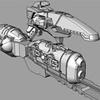
    You remember this one from earlier, right? Try this on for size:

    This is weapon is what I refer to in context as a linear induction rifle (LiR). It fires a tiny osmium-jacketed ferrous grain (~0.0005 kg)accelerated fast enough (~4404 m/s) to have a muzzle energy of ~ 4848 J. The caliber (stamped on the side of the gun...well, scanner didn't pick it up) is written as .606-08, and interpreted as 60.6% of 8 kJ. Ok, we know how coil guns work and we know how railguns work. Peachy. I don't need to explain that much to you.

    Now here's where it gets fun.

    You need energy to actuate such a weapon. It's impractical to have two separate power sources in a firearm; it would be like having separate powder and shot in the old black-powder weapons. So instead we have cartridges that contain both your projectile and your propellant so you only have to worry about loading one thing. Propellant gases and recoil are your means to cycle the weapon for automatic fire. Solution? Combine your grain and your power source into a cartridge that gets disposed of on each shot. Sure it creates complexity by adding moving parts to the system, but it also increases portability. Ok, so what could contain this power? Ultra-capacitors. They are real and in development right now and could replace batteries. They hold massive amounts of energy per volume and can retain it over time. Obviously, though, this gives the ammo a relatively short shelf-life (side-effect: it keeps the military from over-spending).

    So how does this all work together?

    Inside each cartridge is a stack of ultra-capacitors connected to what is essentially a miniaturized rail-gun. They are obviously charged at the factory. It's an open circuit. At the base of each cartridge is what I call an ignition cap. This is simply a piece of copper that gets severed from the base and pushed inwards by a firing-pin. This completes the circuit, causing the weapon to discharge on contact with the bottom of the pit. The grain is fired out into the set of rings that push it to even higher velocities (LiR is somewhat of a misnomer in this regard). The inner components of the cartridge all get vaporized and burned away by the intense energy discharge.

    Now, when the bolt is cycled, it actually primes the cartridge, because the firing pin also serves as a conduit from the energy source to the aforementioned magnetic coils. It energizes those rings when you lock the bolt because the pin travels slightly inwards. There is a drawback to the design. Once you cock the weapon (close the action in this case), you cannot remove the round without permanently wasting it.

    Some gun specific details:
    • holes on magazine show you your ammo level.If the pusher is crossing over the first hole, you know you have 4 rounds left. Second hole, 2 rounds. Total capacity is 5, but 15, 25, and 75 round magazines are available (25 and 75 are normally used in the automatic weapons)
    • there are no physical sights; I need to draw some projectors on, but it uses a UV-laser that reacts with coatings o effectively make a holo-sight in the user's goggles. Why? To make it harder for enemy troops to use it effectively. Why? Technology is at a premium and Perstyr Imperium is the top dog. There are no gradations for distance and windage because the round is traveling so fast that drop and wind are irrelevant at ranges where you can see the target.The recoil and round shape of the grain makes these awful sniping platforms at any rate.
    • fat end of the cleaning rod also doubles as the front bayonet lug.
    • fully stocked to the muzzle in order to protect the more delicate insides. It's not fragile, but bending it out of shape would have disastrous results.

    How does automatic fire work with this system? Recoil energy, just like in many chemically-powered weapons. That said, this tech is fairly new in-world. I have a whole meticulously designed universe for all of this, and it very coherent. I have tons of stuff like this, including a real reasons why they can't just use lasers and traditional ballistics. I can't just say "Rule of Cool" because that undermines believability. If I'm going to do something fictional in my sci-fi, I am going to back it up believably. In my universe, the hardest thing to explain away is FTL. Apart from that, there is little to no hand-wavium going on. If you want to know more, I believe my Steam ID is in the appropriate thread. The point of this exercise is that all you have to do is some research into the physics and technologies that could be behind your idea and you can come up with a rather convincing system. If you want a particular aesthetic style, find a real reason to have it; the solution may not be found in the obvious locations, i.e. you may have to find a social or economic reason for a piece of tech.


    E: If you are working in a universe that isn't this one, make sure you keep your physics consistent, or your product will suck...like space combat in Mass Effect.
    -------------------------------------------------------------------------------------------------------------------------------------------

    Did you read my blurb about artists? It's in Sel's thread about capitalism being detrimental to "art."

    I'll just sum it up here for you in case you don't want to go find it:
    The best art comes from engineers because they use science to understand how everything works together. Their work is natural, fluid, and logical and that leads to a simultaneously pragmatic and aesthetically pleasing result.

    Last edited by Warsaw; March 25th, 2012 at 11:10 AM. Reason: GRAMER! And closing the LIST tag...
    Reply With Quote

  4. #94

    Re: Weapon design and you: how to avoid sci-fi samery

    Very interesting! I actually learned something from that. I've heard something similar about capitalism, that investing can be bad for practically anything in business.
    Reply With Quote

  5. #95
    Gar TVTyrant's Avatar
    Join Date
    Apr 2008
    Location
    Hillsboro, Oregon
    Posts
    4,678

    Re: Weapon design and you: how to avoid sci-fi samery

    But what rim size does it work off of?
    Reply With Quote

  6. #96

    Re: Weapon design and you: how to avoid sci-fi samery

    Quote Originally Posted by Warsaw View Post
    It can be realistic because there it's designed to be utilitarian. A military weapon is a tool, nothing more. It has a job to do and every detail should be geared towards accomplishing that job. Sometimes extrusions make sense as lightening cuts (AK-47 has two huge ones), cavities for moving parts, etc. Most of the stuff you see on science fiction guns is, however, just mindless Greeble. Halo Reach actually wasn't that bad at all, and I'm not going to harp on it. The Halo 4 BR also isn't that bad, but there are a ton of snags all over it that really don't serve any function and couldn't (what are those tabs around the LCD for? Things like that). Even still, the human weapons are literally the same technologies we have today. The AR is a gas-operated assault rifle firing a 7.62 NATO cartridge...that's a cartridge that was adopted 648 years before the events of the first game. So come on, we all know how these guns work, it's the same crap, different century.

    And no, I can't explain *exactly* how a hypothetical weapon would work, but I can get pretty damn close because not only am I a Game Design major, I'm also a Systems Engineering major.

    You remember this one from earlier, right? Try this on for size:

    This is weapon is what I refer to in context as a linear induction rifle (LiR). It fires a tiny osmium-jacketed ferrous grain (~0.0005 kg)accelerated fast enough (~4404 m/s) to have a muzzle energy of ~ 4848 J. The caliber (stamped on the side of the gun...well, scanner didn't pick it up) is written as .606-08, and interpreted as 60.6% of 8 kJ. Ok, we know how coil guns work and we know how railguns work. Peachy. I don't need to explain that much to you.

    Now here's where it gets fun.

    You need energy to actuate such a weapon. It's impractical to have two separate power sources in a firearm; it would be like having separate powder and shot in the old black-powder weapons. So instead we have cartridges that contain both your projectile and your propellant so you only have to worry about loading one thing. Propellant gases and recoil are your means to cycle the weapon for automatic fire. Solution? Combine your grain and your power source into a cartridge that gets disposed of on each shot. Sure it creates complexity by adding moving parts to the system, but it also increases portability. Ok, so what could contain this power? Ultra-capacitors. They are real and in development right now and could replace batteries. They hold massive amounts of energy per volume and can retain it over time. Obviously, though, this gives the ammo a relatively short shelf-life (side-effect: it keeps the military from over-spending).

    So how does this all work together?

    Inside each cartridge is a stack of ultra-capacitors connected to what is essentially a miniaturized rail-gun. They are obviously charged at the factory. It's an open circuit. At the base of each cartridge is what I call an ignition cap. This is simply a piece of copper that gets severed from the base and pushed inwards by a firing-pin. This completes the circuit, causing the weapon to discharge on contact with the bottom of the pit. The grain is fired out into the set of rings that push it to even higher velocities (LiR is somewhat of a misnomer in this regard). The inner components of the cartridge all get vaporized and burned away by the intense energy discharge.

    Now, when the bolt is cycled, it actually primes the cartridge, because the firing pin also serves as a conduit from the energy source to the aforementioned magnetic coils. It energizes those rings when you lock the bolt because the pin travels slightly inwards. There is a drawback to the design. Once you cock the weapon (close the action in this case), you cannot remove the round without permanently wasting it.

    Some gun specific details:
    • holes on magazine show you your ammo level.If the pusher is crossing over the first hole, you know you have 4 rounds left. Second hole, 2 rounds. Total capacity is 5, but 15, 25, and 75 round magazines are available (25 and 75 are normally used in the automatic weapons)
    • there are no physical sights; I need to draw some projectors on, but it uses a UV-laser that reacts with coatings o effectively make a holo-sight in the user's goggles. Why? To make it harder for enemy troops to use it effectively. Why? Technology is at a premium and Perstyr Imperium is the top dog. There are no gradations for distance and windage because the round is traveling so fast that drop and wind are irrelevant at ranges where you can see the target.The recoil and round shape of the grain makes these awful sniping platforms at any rate.
    • fat end of the cleaning rod also doubles as the front bayonet lug.
    • fully stocked to the muzzle in order to protect the more delicate insides. It's not fragile, but bending it out of shape would have disastrous results.

    How does automatic fire work with this system? Recoil energy, just like in many chemically-powered weapons. That said, this tech is fairly new in-world. I have a whole meticulously designed universe for all of this, and it very coherent. I have tons of stuff like this, including a real reasons why they can't just use lasers and traditional ballistics. I can't just say "Rule of Cool" because that undermines believability. If I'm going to do something fictional in my sci-fi, I am going to back it up believably. In my universe, the hardest thing to explain away is FTL. Apart from that, there is little to no hand-wavium going on. If you want to know more, I believe my Steam ID is in the appropriate thread. The point of this exercise is that all you have to do is some research into the physics and technologies that could be behind your idea and you can come up with a rather convincing system. If you want a particular aesthetic style, find a real reason to have it; the solution may not be found in the obvious locations, i.e. you may have to find a social or economic reason for a piece of tech.


    E: If you are working in a universe that isn't this one, make sure you keep your physics consistent, or your product will suck...like space combat in Mass Effect.
    -------------------------------------------------------------------------------------------------------------------------------------------

    Did you read my blurb about artists? It's in Sel's thread about capitalism being detrimental to "art."

    I'll just sum it up here for you in case you don't want to go find it:
    The best art comes from engineers because they use science to understand how everything works together. Their work is natural, fluid, and logical and that leads to a simultaneously pragmatic and aesthetically pleasing result.
    it still looks dumb.
    Reply With Quote

  7. #97
    Posts, posts EVERYWHERE! Warsaw's Avatar
    Join Date
    May 2007
    Location
    State of Pandemonium
    Posts
    8,647

    Re: Weapon design and you: how to avoid sci-fi samery

    Right. It still looks dumb. Because you know exactly everything about the world it comes from and can can make such a statement.

    No. If I found a Halo assault rifle in Unreal Tournament, I would say it looks dumb. If I found your Warthog in Battlefield 3, I would say it looks dumb. Context is everything. Not to mention, that's a technical drawing with no textures or lighting at all. It looks just as dumb as a wire-frame.

    E: I suppose that you think a Lee-Enfield looks dumb, too.
    Last edited by Warsaw; March 26th, 2012 at 10:15 AM.
    Reply With Quote

  8. #98

    Re: Weapon design and you: how to avoid sci-fi samery

    Need to be a balance between greebles and realism. Spam a gun full of greebles for the sake of random detail it's going to look way to busy and obnoxious. Kind of like the Halo 4 BR.
    Reply With Quote

  9. #99

    Re: Weapon design and you: how to avoid sci-fi samery

    This is turning into one massive opinion war. I firmly believe that in this world the most likely type of person to be misunderstood are geniuses. , If they're too dumb to understand where you're coming from, fuck em'. You can't please everybody. I just ignore the haters, I didn't even try to reply to =sw=warlord.

    I don't know why I'm even supporting you Warsaw, as I hate every one of you guyses guts. I only come here for inspiration. Maybe it was the fact that I saw something in your drawings I see in myself. I don't come across a lot of people who actually draw, design, and do it well. And the haters, I've got so many, I know what its like to be hated.
    Last edited by FreedomFighter7; March 26th, 2012 at 09:08 PM.
    Reply With Quote

  10. #100
    Posts, posts EVERYWHERE! Warsaw's Avatar
    Join Date
    May 2007
    Location
    State of Pandemonium
    Posts
    8,647

    Re: Weapon design and you: how to avoid sci-fi samery

    For my part, it's about consistency. If you can explain why your world is the way it is and has the look it does and it maintains that throughout, great. If you say one thing and do another, well, that's just poor form regardless.
    Reply With Quote

Thread Information

Users Browsing this Thread

There are currently 1 users browsing this thread. (0 members and 1 guests)

Bookmarks

Posting Permissions

  • You may not post new threads
  • You may not post replies
  • You may not post attachments
  • You may not edit your posts
  •